Sudan is yet another part of a broader regional struggle, where Iranian influence and resurgent Islamist movements invest in enmity with a clear intent of sabotaging the agenda of cooperation.
Sudan is often viewed primarily through a humanitarian lens, as a devastating civil war unfolding on the periphery of the world’s strategic thinking. Yet what is happening there could have consequences far beyond its borders. Since April 2023, Sudan has been engulfed in a brutal war between the Sudanese Armed Forces (SAF), led by Gen. Abdel Fattah al-Burhan, and the paramilitary Rapid Support Forces, led by Mohamed Hamdan Dagalo, known as Hemedti.
While much of the international conversation has centered on the humanitarian crisis and allegations that the United Arab Emirates has supported the Rapid Support Forces (RSF), far less attention has been paid to another important development: Iran has steadily re-established its relationship with the Sudanese Armed Forces, while Islamist networks tied to Sudan’s Muslim Brotherhood and the former regime of Omar al-Bashir have re-emerged as influential players within the country’s military and political establishment.
Sudan’s war is not driven by a single ideology or foreign power. It is also a struggle over political power, territory, resources, and competing regional interests. The RSF has built significant economic power through its control of gold-trading networks, with much of that gold reportedly sold through markets in the UAE. The UAE has also faced persistent allegations of providing support to the RSF, allegations Abu Dhabi denies. Iran’s interests are different. For Tehran, Sudan offers an opportunity to re-establish influence on the Red Sea while strengthening forces whose interests increasingly intersect with its own. Tehran’s approach in Sudan fits a familiar regional strategy: exploit instability, cultivate strategic and ideological partners, and undermine a regional order built around cooperation.
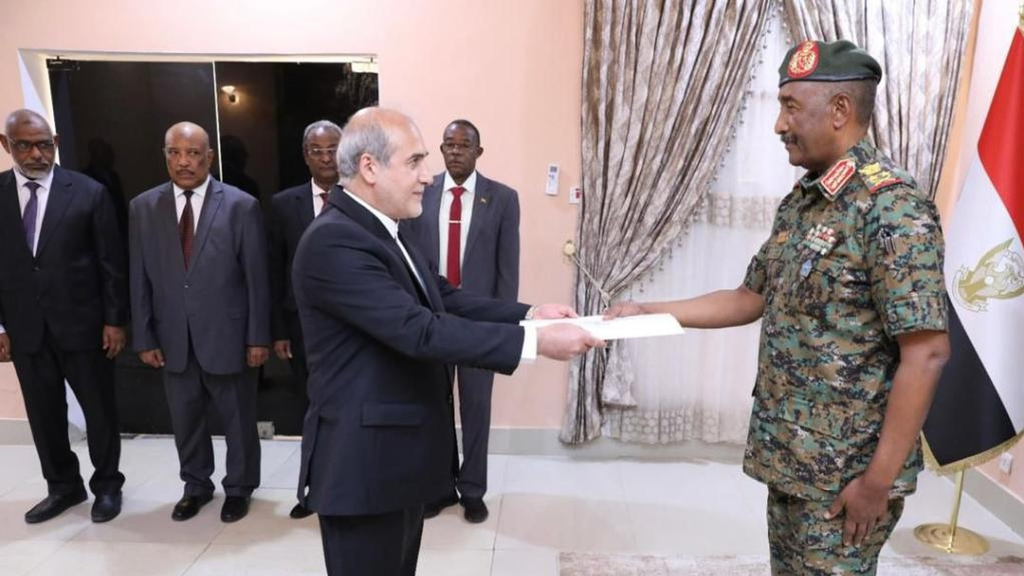
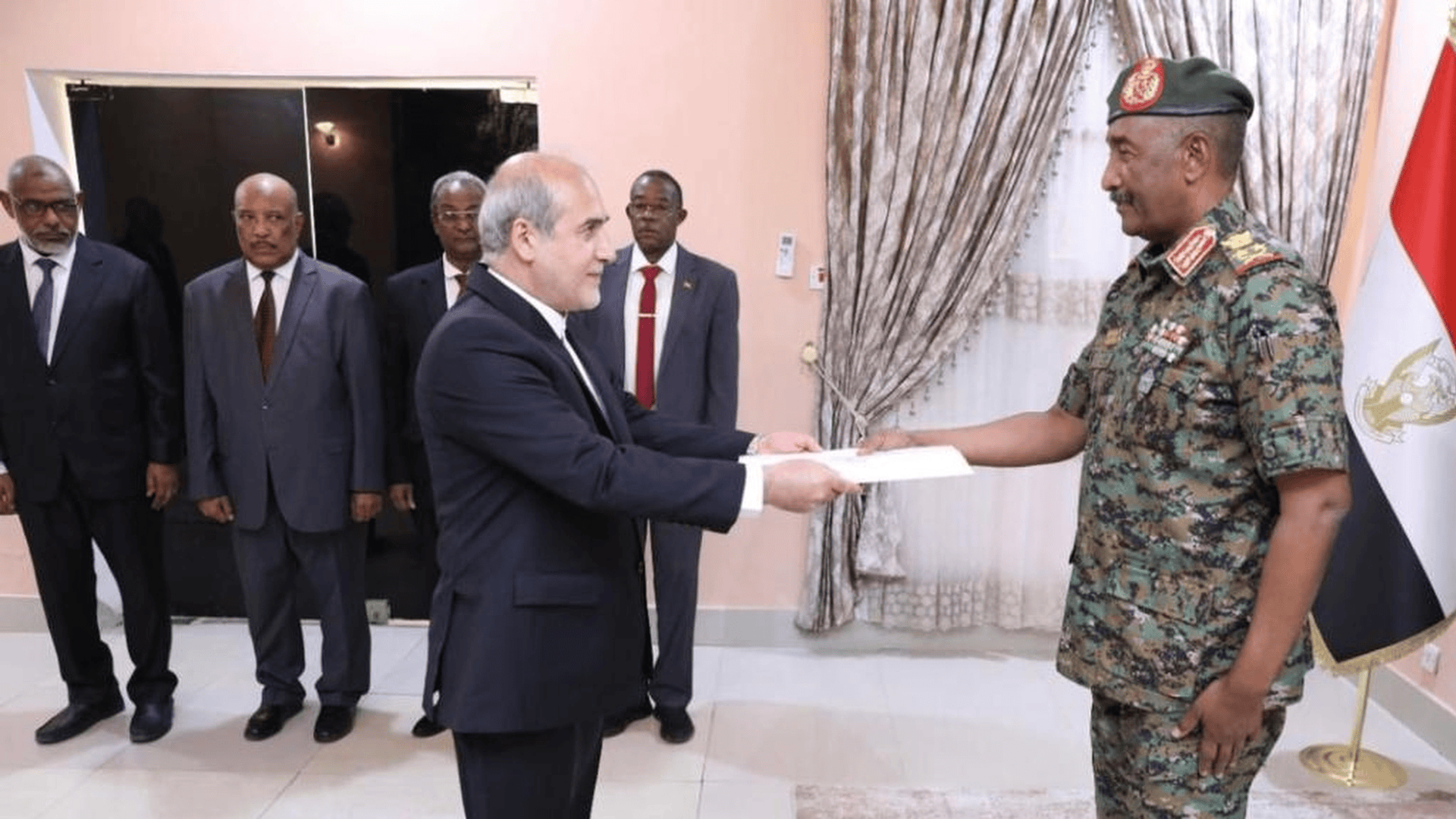
Khartoum and Tehran restored diplomatic relations in late 2023. Soon afterward, Iranian-made drones began appearing in the SAF’s arsenal, significantly strengthening its battlefield capabilities against the RSF
Iran’s relationship with Sudan’s Islamist forces is not new. For decades under President Omar al-Bashir, Sudan was governed by an Islamist regime that emerged from the political movement led by Muslim Brotherhood ideologue Hassan al-Turabi, who maintained close links with Tehran. Bashir’s fall in 2019 appeared to open the door to a different Sudan, one moving away from Islamist rule and Iran and eventually toward normalization with Israel. Today, many of the same forces that once defined Sudan’s regional orientation are finding their way back.
Khartoum and Tehran restored diplomatic relations in late 2023. Soon afterward, Iranian-made drones began appearing in the SAF’s arsenal, significantly strengthening its battlefield capabilities against the RSF. Iranian Mohajer and Ababil drones have played an important role in the army’s advances, while flight-tracking data documented repeated cargo flights by Iran’s sanctioned Qeshm Fars Air between Iran and Port Sudan. These new capabilities helped the SAF regain territory and marked Iran’s return as a significant military player in Sudan’s war.
Iran’s support for the SAF also intersects with the resurgence of Sudan’s Islamist networks. In 2026, the United States designated the Sudanese Muslim Brotherhood as a terrorist organization, identifying the al-Baraa Bin Malik Brigade as its armed wing. According to the U.S. State Department, the organization has contributed upwards of 20,000 fighters to the war, many of whom received training and other support from Iran’s Islamic Revolutionary Guard Corps. The designation provides a direct link between the return of Sudan’s Islamist forces and Tehran’s growing involvement in the conflict.
The prospect of Tehran establishing greater influence along another stretch of the same strategic corridor should concern countries far beyond Sudan’s immediate neighborhood
Iran is not the only regional power moving into this space. Turkish defense companies have also deepened their involvement in Sudan, supplying the Sudanese Armed Forces with drones, munitions, and weapons, as Ankara seeks to expand its influence in Sudan and along the Red Sea while maintaining longstanding ties with Sudanese Islamist networks. Turkey’s motivations may differ from Tehran’s, but the growing involvement of both countries in support of the SAF, alongside the resurgence of Islamist forces within its camp, adds another dimension to the broader regional contest between political Islam and the regional order represented by the Abraham Accords.
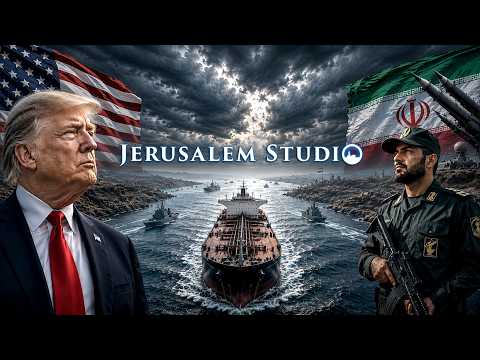
Situated along the Red Sea, Sudan occupies a critical position along a corridor where, under normal conditions, roughly 15% of global maritime trade volume passes through the Suez Canal. At a time when Iran-backed Houthi attacks have already disrupted international shipping, the prospect of Tehran establishing greater influence along another stretch of the same strategic corridor should concern countries far beyond Sudan’s immediate neighborhood.
It wasn’t that long ago that Sudan was on a path toward a very different future. In 2020, Sudan agreed to move toward normalizing relations with Israel under the U.S.-brokered Abraham Accords. That decision was about more than ties with Israel. It signaled a broader shift in Sudan’s regional alignment, away from isolation and political Islam and toward cooperation, economic integration, and the emerging regional order.
Today, that trajectory has been dramatically reversed. The civil war, combined with Iran’s renewed influence and the resurgence of Muslim Brotherhood-linked Islamist networks within Sudan, has pushed that vision further out of reach. As Tehran strengthens its foothold, the prospect of normalization has steadily faded, making Sudan another example of how Iranian influence can pull countries away from regional integration and toward greater instability.
Sudan illustrates how quickly a country’s trajectory can be reversed when the forces driving instability are underestimated
The Abraham Accords challenged the assumption that peace in the Middle East had to wait for every conflict to be resolved. More importantly, they represented the emergence of a different regional order, one built on shared interests, economic cooperation, and partnership rather than perpetual hostility. Iran understood the implications immediately. Unlike traditional military alliances, the Abraham Accords threatened Tehran through success rather than force. Every new relationship between Israel and its Arab neighbors weakened the ideology of perpetual confrontation that underpins Iran’s ‘Axis of Resistance.’
Iran has done far more than simply oppose normalization. The October 7 Hamas massacre came as negotiations between Israel and Saudi Arabia were advancing toward what could have become one of the most consequential normalization agreements in the region. Hezbollah, another Iranian proxy, subsequently opened a northern front against Israel, further destabilizing the region at precisely the moment when new diplomatic possibilities were being tested. For Tehran, normalization is not merely a diplomatic disagreement. It is a strategic threat.
Sudan illustrates how quickly a country’s trajectory can be reversed when the forces driving instability are underestimated, allowing powers like Iran to step in. What is happening in Sudan is far more than an internal conflict. It is another arena in a broader contest over the future of the MENA region at large.
The Abraham Accords represented a choice between two competing visions: The first, envisions a region where Israelis, Emiratis, Bahrainis, Moroccans (and one day Sudanese) do business, invest together, innovate together, and develop partnerships rather than enmities. The second envisions the continuation of conflict, invests in proxy warfare, ideological extremism and perpetual instability which seeks to sabotage peace whenever it begins to take root.
Dr. Nir Boms is a researcher on Syria and a Senior Fellow at the Forum for Regional Cooperation at Tel Aviv University. Yaara Segal is an Abraham Accords expert and MENA strategy and communications consultant. She previously served in Israel’s Foreign Ministry and as senior adviser to Israel’s ambassador to the UAE.